
Neuro-Adaptive Mathematics Learning
Beyond Universal Solutions
Understanding the origin of cognitive load is critical because an overloaded brain cannot build the necessary schemas for deep mathematical understanding. Simply detecting that a student is struggling is not enough. By identifying whether the difficulty is computational (centered in the IPS), verbal (centered in the Angular Gyrus), or visual (Occipito-temporal), our system provides precise "scaffolding". This ensures that every learner stays in their personal Goldilocks Zone — where tasks are challenging enough to stimulate growth without becoming overwhelming. The result is learning that is more efficient, fair, and enjoyable.


Decoding the Origin of Effort
The COVID-19 pandemic triggered an unprecedented shift in education, as millions of students moved almost overnight to remote learning through screens. This rapid transition exposed a fundamental flaw in traditional systems: they operate on a "one-size-fits-all" approach, remaining blind to the individual differences among learners. While a human teacher might notice when a student looks disengaged or confused, digital systems currently cannot pinpoint the exact mental state or the precise moment when confusion and fatigue begin.
Our project offers a neuro-adaptive solution based on passive Brain-Computer Interface (BCI) technology. It creates a direct channel that monitors and classifies mental states in real time. The system integrates two complementary measures: EEG, which records key biomarkers such as Theta and Alpha waves, and Pupillometry, which reflects activity in the Locus Coeruleus — the brain’s arousal hub. Using machine learning and the Triple Code Model, the system dynamically builds and adjusts exercises to keep every learner in the "Goldilocks Zone" (Zone of Proximal Development – ZPD) — the ideal range where learning is most effective.

Where is it Used?
Brain-Computer Interface technology is already moving from research labs into real-world applications to save lives and improve learning:
-
Aviation & Surgery - Simulators use brain and pupil signals to detect mental overload and prevent critical human errors.
-
Assistive Communication - For patients with “Locked-in” syndrome, small changes in pupil size and brainwaves serve as a direct channel to computers.
-
Medical Diagnostics - Physiological signals act as objective biomarkers for early detection of ADHD, depression, and cognitive decline.
-
Education - Research prototypes like the Neurotutor automatically adjust math difficulty based on detected cognitive load.
Our Innovation: Understanding the “Why” While most existing systems can only tell that a student is struggling, our project goes further.
What You Will Learn on This Site
On this website, you will discover how the
brain processes numbers through the Triple Code Model, engage in interactive challenges designed to reveal your own cognitive patterns (such as the Octal Challenge), and learn to analyze real physiological data with hands-on Python code. Together, we will explore how neurotechnology is shaping the future of personalized, brain-aware learning.
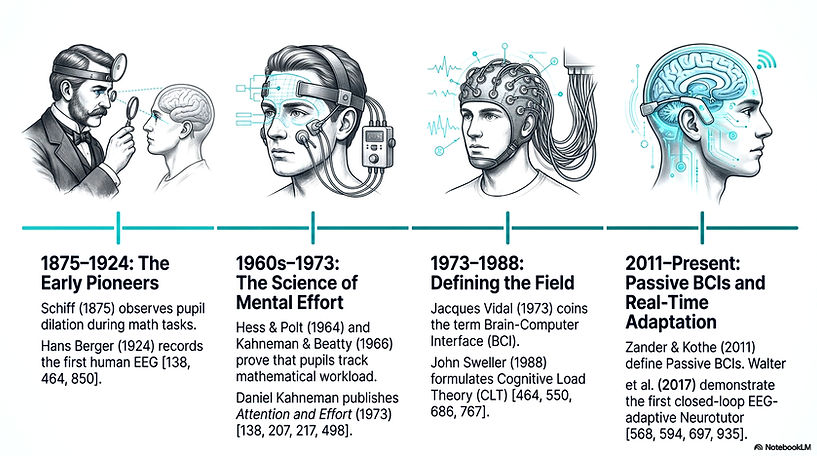
A Short History
The journey to understand mental effort began long before modern computers. It started with the simple realization that our bodies physically react to the weight of our thoughts.
-
1875–1924: The Early Pioneers In 1875, scientist Schiff made the groundbreaking observation that the human pupil expands simply by performing mental arithmetic. Decades later, in 1924, Hans Berger recorded the first human EEG — capturing the brain’s faint electrical activity for the very first time.
-
1960s–1973: The Science of Mental Effort Researchers Hess & Polt (1964) and Kahneman & Beatty (1966) proved using analog film that pupil size changes in proportion to mathematical difficulty. At the time, capturing these subtle signals was a massive challenge, often requiring "jury-rigged" arrays of pulleys and mirrors just to see the eye clearly. In 1973, Daniel Kahneman published his influential work Attention and Effort, defining how our brain manages its limited resources.
-
1973–1988: Defining the Field The term “Brain-Computer Interface” (BCI) was coined by Jacques Vidal in 1973. In 1988, John Sweller introduced Cognitive Load Theory (CLT), providing the framework we use today to understand why an overloaded brain struggles to learn.
-
2011–Present: Passive BCIs and Real-Time Adaptation We have now moved from bulky, restrictive lab setups to lightweight, real-time systems. The introduction of Passive BCIs (Zander & Kothe, 2011) allowed for monitoring the brain without the user needing to perform specific commands. Finally, the first closed-loop “Neurotutor” (Walter et al., 2017) marked the beginning of adaptive learning systems that respond and adapt directly to the brain’s signals in real-time
Scientific Foundations
The Science of Cognitive Load Monitoring
What is Cognitive Load?
Efficient learning depends on how well we manage Working Memory - a system with limited capacity that temporarily holds and processes information. Our goal is to build a system that can detect, in real time, when this memory reaches its capacity threshold - the point at which the brain can no longer effectively process new information or transfer it to long-term memory.
According to the Yerkes-Dodson Law, performance improves as mental arousal increases, but only up to an optimal point. Our system aims to keep every learner in the Zone of Proximal Development (ZPD), also known as the "Goldilocks Zone" - the ideal range where a task is challenging enough to promote growth, but not so difficult that it blocks learning.

The Architecture of Thought: Working Memory and Cognitive Load
Understanding students' mathematical performance requires consideration of both the cognitive resources available during learning and the neural systems responsible for numerical processing. Working memory provides the limited mental workspace in which information is temporarily maintained and manipulated. Its central executive allocates attention and coordinates processing, while the phonological loop supports verbal information and arithmetic facts, and the visuospatial sketchpad maintains visual and spatial representations essential for mathematical tasks. Because working memory has limited capacity, Cognitive Load Theory (CLT) distinguishes between intrinsic load, arising from the inherent complexity of the material; extraneous load, resulting from inefficient instructional design; and germane load, the productive effort invested in constructing meaningful knowledge.
Physiological Biomarkers: EEG and Pupillometry
To "read" the learning brain in real time, we use two powerful technological windows:
Electroencephalography (EEG): Sensors on the scalp measure the tiny electrical signals produced by neurons. We focus on biomarkers such as increased Frontal Theta waves (indicating working memory effort) and decreased Parietal Alpha waves (indicating deep concentration and focus).
Pupillometry: Precise tracking of pupil size. The pupil acts as an objective "effort meter," expanding automatically as mental demand and task difficulty rise.


The Biological Engine: The LC-NE System and the Pupil
The connection between mental effort and pupil size is controlled by the Locus Coeruleus-Norepinephrine (LC-NE) system. The Locus Coeruleus, a small nucleus in the brainstem, releases norepinephrine to regulate arousal and allocate mental resources. When cognitive demand increases, this system triggers pupil dilation, giving us a clear, real-time window into the learner’s level of intensity and effort.

The Triple Code Model: Understanding the Source of Difficulty
While working memory and cognitive load describe the cognitive demands imposed during learning, the Triple Code Model explains the distinct systems through which mathematical information is represented and processed. According to this model, numerical cognition relies on three complementary codes: the computational system, centered in the Intraparietal Sulcus (IPS), which supports quantity representation and calculation; the verbal system, associated with the Angular Gyrus, which stores and retrieves arithmetic facts and mathematical language; and the visual system, located in the occipito-temporal cortex, which enables the recognition of digits and mathematical symbols (the Arabic code). Together, these frameworks distinguish between limitations arising from the learner's available cognitive resources and those stemming from the specific cognitive systems engaged in mathematical processing.

Adaptive Logic and the Triphasic Model
To turn biological signals into real teaching decisions, the system follows the Triphasic Model of pupil response:
-
Increase - The student begins the task and mental resources are mobilized.
-
Plateau - The learner is actively engaged in the optimal learning zone (ZPD).
-
Decline - The most important warning signal. It shows that working memory capacity has been exceeded and the student is starting to disengage due to overload.
When the system detects this breaking point, it automatically reduces the task difficulty. The adjustment is based on the Q-value - a mathematical score that calculates the objective difficulty of a problem according to the number of operations and “carries” it requires.

The Technology Pipeline From Raw Signals to Real-Time Adaptation
How does a computer “read” your mental effort in real time? Our system follows a clear 5 stage pipeline that turns biological signals into smart, personalized learning support:
-
Multimodal Data Acquisition The system simultaneously records raw EEG signals (especially Frontal Theta and Parietal Alpha) and high-speed Pupillometry at 120Hz.
-
Preprocessing & Cleaning To maintain scientific accuracy, we remove motion and muscle artifacts. Blink data is reconstructed using cubic-spline interpolation.
-
Feature Extraction (Catch-22) We extract 22 dynamic descriptors from the time-series data using the Catch-22 library. This includes entropy (temporal complexity) and the Theta/Alpha power ratio — far more informative than simple frequency analysis.
-
AI Mental State Classification The features are fed into an XGBoost model trained to diagnose the source of difficulty according to the Triple Code Model: computational (IPS), verbal (Angular Gyrus), or visual (Occipito-temporal).
-
Closed-Loop Adaptation In real time, the system adjusts the task’s Q-value (objective difficulty). If overload is detected, difficulty is reduced; if the student is under-challenged, the task becomes more demanding — always aiming to keep the learner in the optimal Goldilocks Zone (ZPD).

The Octal Arithmetic Challenge
Breaking Mental Automation
What is the Octal Challenge? Most of our daily math is performed in Base-10 (decimal). Over years of practice, operations like 5+5=10 become automated, stored as "verbal facts" in the brain’s Angular Gyrus. The Octal Challenge forces you to calculate in Base-8 (where 5+5=128).
The Science Behind the Game: By changing the number system, we bypass your brain's "System 1" (automatic retrieval) and force the recruitment of System 2 (active computation). This shift "ignites" the Intraparietal Sulcus (IPS) and the Prefrontal Cortex (PFC).
Watch Your Brain React: As you struggle to hold these new rules in your Working Memory, your brainstem’s Locus Coeruleus releases norepinephrine, causing your pupils to dilate in a specific Phasic Dilation pattern. If the task exceeds your Zone of Proximal Development (ZPD), our system will detect a Plateau or a Decline in pupil size—a clear biological signal that you’ve reached your "breaking point" and need support.

Try It Yourself
See Your Brain in Action
Want to experience how your own brain responds to math?
Try these simple home experiments:

-
The Mirror Arithmetic Challenge Stand in front of a mirror in steady light. Solve an easy problem (2+2) and notice how your pupil stays stable. Then try a harder one (14×17) and watch your pupil dilate at the peak of effort. Finally, attempt something impossible, when you give up, you’ll see the pupil shrink, signaling disengagement.
-
The Octal Challenge Try adding numbers in base-8 (for example, 5+5=12).
Feel how your brain is forced to work harder instead of relying on memorized facts.
-
Future Applications:
-
Beyond the Classroom This technology has exciting potential far beyond math education: from early diagnosis of learning disabilities and objective measurement of true mastery, to future AR glasses that offer real-time visual support exactly when your brain needs it most.
-
Ready to explore more? Dive into the interactive challenges on this site and discover how neurotechnology can transform the way we learn.

Challenges and Limitations
Bringing this technology into real classrooms is exciting, but several challenges remain:
-
Lighting Interference - The pupil reacts much more strongly to changes in light and screen brightness than to thinking itself. Isolating the “mental effort” signal outside a controlled lab is difficult.
-
Movement Artifacts -Blinks, head turns, and talking create noise in both EEG and eye-tracking data.
-
Individual Differences -Every student has a unique physiological profile (age, glasses, eye shape), requiring careful calibration.
-
The “Giving Up” Problem -When a student disengages from a difficult task, their brain signals can look similar to those of a bored student- making it hard for the system to tell the difference.

Open Questions
What Science Still Needs to Answer:
-
Can we detect the biological “Aha!” moment when a student truly understands a new concept?
-
Can the system predict overload before it happens?
-
How can we reliably separate “hard thinking” from “emotional frustration”?
-
If we always keep students in the comfortable “Goldilocks Zone,” will they lose the ability to handle real world struggle?
-
Do these brain markers work the same way in young children as they do in adults?

Ethics and Rights
Reading the brain raises important ethical and legal questions, often referred to as Neurorights:
-
Mental Privacy — Brain and pupil data are highly personal and must remain the student’s property, never sold or misused.
-
Psychological Continuity — Technology should not alter a student’s sense of identity or self.
-
Cognitive Liberty — Students must retain the freedom to think and choose without hidden algorithmic influence.
-
Fair Access — This technology must be available to all students, not just those who can afford it, to avoid widening educational gaps.
References
-
Berger, H. (1924). Über das Elektroenkephalogramm des Menschen. Archiv für Psychiatrie und Nervenkrankheiten.
-
Dehaene, S., & Cohen, L. (1995). Towards an anatomical and functional model of number processing. Mathematical Cognition, 1(1), 83-120.
-
Hess, E. H., & Polt, J. M. (1964). Pupil size in relation to mental activity. Science, 143(3611), 1190-1192.
-
Kahneman, D. (1973). Attention and Effort. Prentice-Hall.
-
Kahneman, D., & Beatty, J. (1966). Pupil diameter and load on memory. Science, 154(3756), 1583-1585.
-
Mathôt, S. (2023). Modern pupillometry: Cognition, neuroscience, and practical applications. Modern Pupillometry.
-
Rozado, D., & Duenser, A. (2015). Combining EEG with pupillometry to improve cognitive workload detection. Frontiers in Human Neuroscience.
-
Schiff, M. (1875). La pupille considérée comme esthésiomètre. La Tribune Médicale.
-
Sweller, J. (1988). Cognitive load theory, learning difficulty, and instructional design. Learning and Instruction.
-
Vidal, J. J. (1973). Toward direct brain-computer communication. Annual Review of Biophysics and Bioengineering.
-
Walter, C., et al. (2017). The first closed-loop "Neurotutor": Adaptive learning systems in real-time.
-
Zander, T. O., & Kothe, C. (2011). Towards passive brain–computer interfaces: Applying remote brain sensing to human–computer interaction. Frontiers in Human Neuroscience.