


Introduction
The P-300 Speller is a brain-computer interface (BCI) that allows people to interact by focusing their attention on a screen. One important application of this BCI is as an assistive technology (AT), providing an alternative communication channel for people who have lost voluntary muscle control.

It uses electroencephalography (EEG) to record and detect brain activity, specifically event-related potentials (ERPs), through sensors placed on the scalp. Instead of relaying on muscles to communicate, the system detects a specific ERP called the P-300: a positive deflection in the EEG that occurs approximately 300 milliseconds after a relevant or unexpected stimulus. In practice, when a user focuses on a character on the screen, the BCI utilizes the P-300 ERP to translate the user’s attention into computer input.
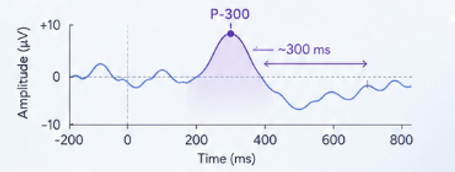
This webpage traces the P-300 Speller from its original design to modern improvements. It explains how P-300-based BCIs work, examines methods for improving speed, efficiency, and accuracy, and presents a concrete example of an improved system. It also highlights why further research is needed to improve its useability as AT in real-world environments and considers the aspect of developing spellers based on users' cognitive abilities.

The P-300 Speller was first introduced by Farwell and Donchin in 1988. Their original interface featured a 6×6 matrix containing the 26 alphabet letters and various commands, based on the oddball paradigm. In this paradigm, a user is presented with a sequence of events divided into two categories: frequent non-target stimuli and rare target stimuli – which can elicit the P-300 ERP.
Farwell and Donchin’s showed that healthy volunteers could communicate at a rate of approximately 2.3 characters per minute with 95% accuracy. While this is slow compared to traditional typing, this technology does not rely on physical movement, making it an important AT for people who may not be able to communicate otherwise.
This development served as the conceptual starting point for decades of neurotechnology research. Modern advancements now focus on improving interface layout, flashing techniques, channel selection and classification algorithms designed to improve the speed, accuracy, usability, and efficiency of P300-based BCIs.

The original P-300 speller matrix. Adapted from Farwell & Donchin (1988).
How the P-300 Speller Works: General Step-by-Step Flow
Visual Speller Display
The user is shown a matrix containing letters, symbols, commands, or word shortcuts.

Row-Column Paradigm (RCP)
Rows and columns flash one after another in a randomized order. When the row or column containing the target character flashes, it becomes a rare and relevant stimulus, thus eliciting a P-300 ERP.
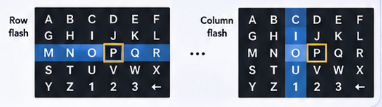
EEG Preprocessing & Feature Extraction
After each flash, the system cuts out a short
EEG window, a few hundred milliseconds after the stimulus. These windows are filtered, cleaned, segmented and important signal features are extracted.

Offline Training
The system collects EEG data while the user focuses on known target characters. These recordings create a dataset with labeled examples of target and non-target responses. Because EEG responses differ greatly among people, each individual has its own training model

Classification Model Learning
Subjects differ in their ability to use the system and in the relative effectiveness of different detection algorithms. Thus, different classification algorithms, such as Step-Wise Linear Discriminant Analysis, Logistic Regression (LR), Support Vector Machine (SVM) are being trained on the labeled dataset: they evaluate each EEG segment and score it based on resemblance to a
P-300 target response.

Online Signal Acquisition
During real-time spelling prediction, the user focuses on a desired character while the system records new EEG signals.

Online Classification and Character Prediction
The classification algorithm scores the EEG responses after each flash. The row and column that elicited the strongest P-300 response are identified, and their intersection is selected as the desired character
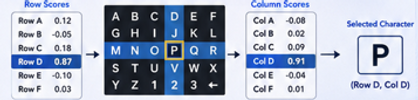
Final Output and Feedback
The result is displayed, giving the user feedback and allowing correction if needed.

Provided in the link below is a highly detailed yet simplified tutorial of a simulated P300 Speller experiment. It walks through the full process, including a 6×6 character matrix, RCP animation, synthetic EEG dataset generation and analysis, signal cleaning, feature extraction, classification model training, character and word prediction, and overall accuracy evaluation.
https://colab.research.google.com/drive/1YVaxfPaM72pIl4zkbeEV1D3LJETP7xMJ?usp=sharing
Improving P-300 Speller Performance
P-300 spellers must balance between speed, efficiency and accuracy – a faster system can increase the Information Transfer Rate (ITR), but it may also reduce accuracy.
In addition, long use can also cause visual fatigue, which may reduce the strength of the P-300 response and lower detection performance. Therefore, researchers are trying to look for methods to improve the performance of P-300 spellers.

Interface Design & Paradigms
One way to improve P-300 spellers is to redesign the flashing paradigm. While RCP is commonly used, other paradigms try to make target detection faster or more accurate. Some systems flash individual characters, which can improve accuracy but also increase detection time.
Alternatively, there are attempts to redesign the BCI's interface. For example, modern research used a larger 7x7 matrix, which included shortcuts characters for common words. While detection time increased, selecting a word through a shortcut character reduces the spelling time.

Single character flashing paradigm Adapted from Pan et al., (2022).

7x7 matrix interface. Adapted from Aygün & Kavsao˘glu (2022).
Hybrid Signals and Multisensory BCI
P-300 responses aren't inclusive to visual stimuli. Multisensory systems, such as audio-visual spellers, have been shown to outperform both the uni-visual and uni-audio P300 spellers, can help users focus and may make the task easier to understand. However, in those BCIs, multisensory stimuli often take longer to present, which can reduce ITR.
Another strategy is to combining P-300 with other brain signals, such as steady-state visual evoked potential (SSVEP). In theory, hybrid systems should increase ITR compared with the single-modal P-300 spellers. However, individuals may show stronger neural responses to some types of stimuli than to others, which affects how clearly different responses appear. Thus, if one signal is not detected clearly, the whole hybrid system may become less reliable.

Audiovisual P-300 BCI speller. Adapted from Pan et al., (2022).
Classification Algorithms
Researchers can also improve P-300 spellers by enhancing classification algorithms performance. Some systems use dynamic stopping methods, where the system stops flashing once it is confident enough about the target character, which reduces unnecessary repetitions and improves overall efficiency.
Channel Selection
Another way to improve P-300 speller performance is by selecting the most useful EEG channels (electrodes) - not every channel contributes equally to the detection of the P-300 ERP. Some channels may carry strong task-related information, while others may add noise or increase the system’s complexity.
Channel selection aims to reduce channels that are less informative without compromising classification performance. This process can reduce computational complexity, lower the risk of overfitting, and make the system more practical and comfortable for users.
Researchers use several approaches to choose the best channels. In some cases, channels are selected manually based on prior knowledge of where P-300 responses are usually the strongest. More advanced methods use data-driven techniques to test which channels improve performance.
Wrapper techniques
Channel selection is treated as part of the classification process: it evaluates different channel subsets by checking how well a classification algorithm performs with them. For example, optimization methods such as Particle Swarm Optimization can search for channel subsets that improve classification accuracy.

Channel selection wrapper techniques workflow. Adapted from Bhandari et al., (2024).
Filter techniques
EEG channels are selected before classification by measuring how relevant each channel is to the target response. These methods may use measures such as mutual information, correlation, or statistical distance. Some researches selected channels with maximal dependence on the targeted class and minimal reliance on themselves.

Channel selection filter techniques workflow. Adapted from Bhandari et al., (2024).
Embedded techniques
The channel selection process is incorporated into the training of the classification algorithm. In this approach, the model learns which channels are most useful while it is being built. Some systems use deep learning methods, such as channel-wise convolution, to identify reliable channels and reduce the effect of noisy ones.

Channel selection embedded techniques workflow. Adapted from Bhandari et al., (2024).
An Improved Interface: The BCI P-300 Speller Easy Screen

The Easy Screen P-300 Speller interface. Adapted from Aygün & Kavsao˘glu (2022).
The Easy Screen P-300 Speller is a modern P300 BCI that uses a 7×7 matrix interface containing the alphabetic letters, a delete (<–), transfer expression character (≫) and 20 symbols characters (E1–E20). The rows and columns flash randomly using RCP, with each flash lasting 100 ms followed by a 75 ms fade. 16 channels were manually chosen, and Linear Discriminant Analysis (LDA), LR and SVM were used as the classifications algorithms
The user’s information is entered (Element 1) to create a personalized model. The training session begins by pressing “Start to Education.” The user focuses on a target character in the matrix, (Element 4) while EEG signals are recorded. Each selected training character appears in Element 5. After enough training runs are collected, “Stop the Education” is pressed to create the user’s classification model.
Next, the user’s trained model is selected (Element 7), and prediction begins by selecting “Enter The User name.” If a letter was predicted , it appears in Element 6, and the word list (Element 3) updates with possible words starting with this letter. The user can either continue to focus on letters or on one of the shortcut symbols (E1–E20). If a shortcut is selected, the matching word from the word is transferred into the final sentence area (Element 8). If the user selects ≫ the word currently built in Element 6 is also moved to Element 8.
New words can be added manually using the “Add The Words” button (Element 2), or automatically when the user spells a new word letter by letter which allows the system to learn useful words over time
For the majority of subjects, using LDA resulted in higher character-detection accuracy than the other tested classifiers
Using the Easy Screen P300 Speller, the same word could be displayed in an average of 1.31 minutes, compared with 4.53 minutes using a conventional P300 speller.
From The Lab to Real-World Application
Most contemporary P-300 BCI studies rely on healthy participants. This can make results look stronger than they may be for individuals who need AT to communicate.
In a study comparing healthy participants with users diagnosed with ALS, multiple sclerosis, spinal cord injury, or acquired brain injury, healthy participants performed better with higher accuracy and ITR. Still, most diagnosed users reached or came close to the minimum accuracy level considered necessary for communication.
The study also showed that cognitive profile strongly affected performance. Diagnosed users without cognitive deficits achieved higher accuracy and ITR, while those with cognitive deficits showed lower results on both measures.
These findings suggest that P-300 BCI performance is influenced more by users’ cognitive abilities than by diagnosis or physical severity alone. Thus, future research could focus on adapting P-300 BCIs to users’ cognitive profiles. This may include making stimuli easier to detect, personalizing calibration, or using neural signals that better match each user’s abilities.

P-300 Spellers show real promise as AT. However, there is still a long way from
P-300-based BCI research to practical application:
User comfort and real-world usability
Many P-300 spellers are still designed mainly from a research perspective, not from the daily needs of users. Further research is needed to make these systems more comfortable, intuitive, and practical outside the lab.

Low ITR
P-300 spellers often have a relatively low ITR compared with natural communication methods. Future work should continue improving ITR while preserving the reliability and accessibility that make these systems valuable for people with communication disabilities.

User-friendly channel selection
Although channel selection can reduce complexity and improve performance, many methods still require recording from a full EEG setup before selecting the best channels. More practical approaches are needed for real-world use, with fewer electrodes and easier setup.

Limited datasets and participant diversity
Many studies rely on small datasets or limited participant groups. Larger and more diverse studies are needed to better understand user variability and improve the general reliability of P-300 speller systems.


Bibliography
Aygün, A. B., & Kavsaoğlu, A. R. (2022). An innovative P300 speller brain–computer interface design: Easy screen. Biomedical Signal Processing and Control, 75, 103593. https://doi.org/10.1016/j.bspc.2022.103593
Bhandari, V., Londhe, N. D., & Kshirsagar, G. B. (2024). A Systematic Review of Computational intelligence techniques for channel selection in P300-Based Brain Computer Interface Speller. Artificial Intelligence and Applications, 2 (3), 155–164. https://doi.org/10.47852/bonviewaia42021390
Farwell, L., & Donchin, E. (1988). Talking off the top of your head: toward a mental prosthesis utilizing event-related brain potentials. Electroencephalography and Clinical Neurophysiology, 70(6), 510–523. https://doi.org/10.1016/0013-4694(88)90149-6
Galiotta, V., Caracci, V., Toppi, J., Pichiorri, F., Colamarino, E., Cincotti, F., Mattia, D., & Riccio, A. (2025). P300-based brain–computer interface for communication in assistive technology centres: influence of users’ profile on BCI access. Journal of Neural Engineering, 22(3), 036044. https://doi.org/10.1088/1741-2552/addf7f
Pan, J., Chen, X., Ban, N., He, J., Chen, J., & Huang, H. (2022). Advances in P300 brain–computer interface spellers: toward paradigm design and performance evaluation. Frontiers in Human Neuroscience, 16, 1077717. https://doi.org/10.3389/fnhum.2022.1077717