
P300

P300 simulator explanation:
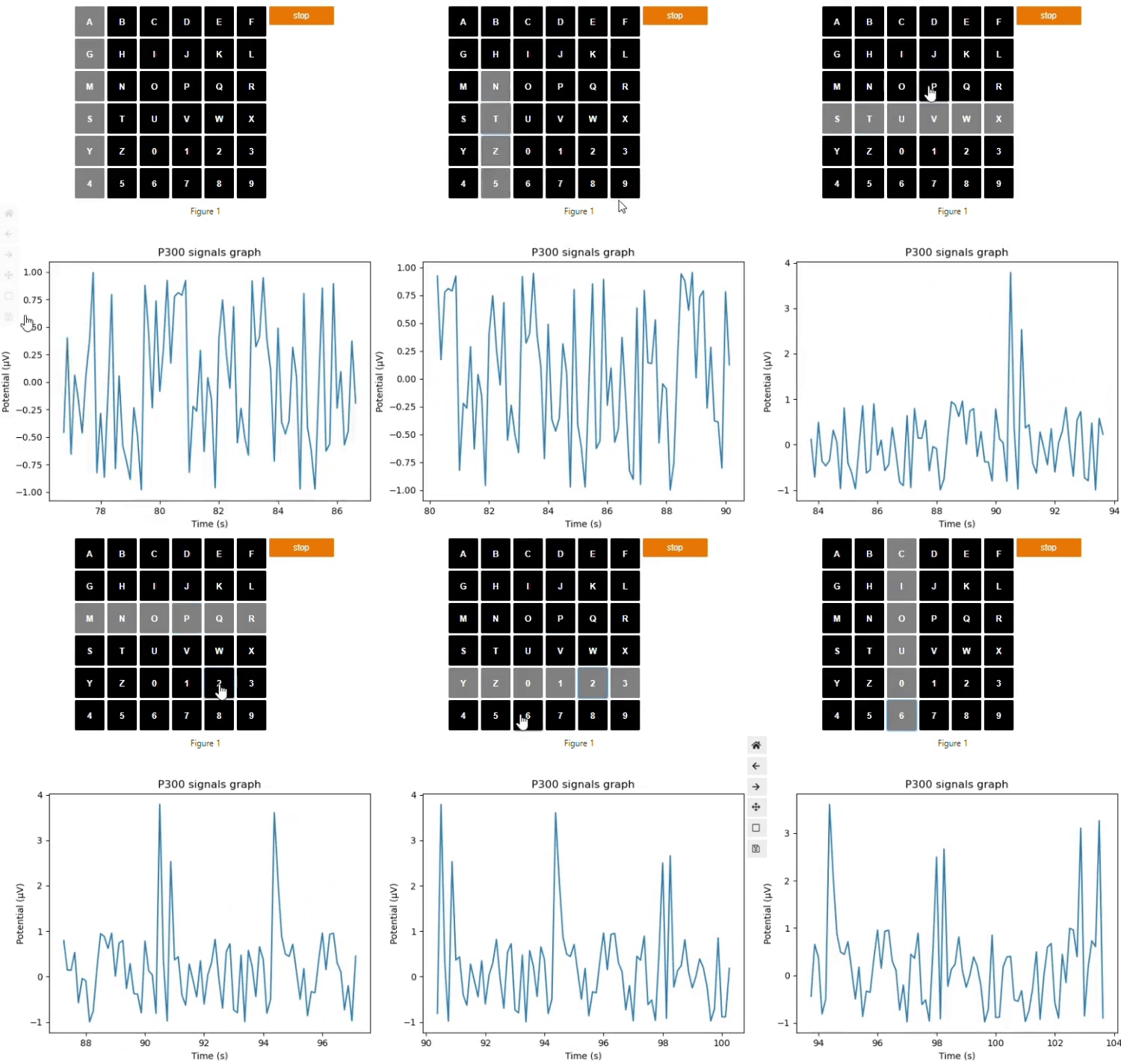
The following is a simulation that shows how using p300-based brain computer interface (BCI) looks like.
The 6x6 buttons grid simulates the interface, by clicking on a button you simulate the user concentrating on said button.
The interface will then start flashing rows and columns in order to see which button you meant, and when the chosen button column/row is flashed.
After approximately 300 miliseconds - the graph, which simulates brain signal detection of the p300 signal, will show a bump that the brain interface system uses to understand which button the simulated user supposedly looked at.
Two options to run the code for this simulation (read the instructions inside the file):
1. Copy this following link to Google Colab notebook (low refresh rate):
https://colab.research.google.com/drive/13Ijxa8YsAeeXMbjrG0my9XXHYQyWX7Ur?usp=drive_link
2.Better option with great refresh rate (here I worked on the code). Note that you need to sign in to anaconda in order to use the notebook.
https://anaconda.cloud/share/notebooks/26c927d3-4fc6-421e-aaef-d38ebd76146d/overview
Overview of P300 in BCIs
P300 is an event-related potential (ERP) characterized by a positive deflection in voltage that occurs approximately 300 milliseconds after the presentation of a rare or significant stimulus. It is a crucial component in many BCIs due to its reliability and ease of detection, particularly in the context of the oddball paradigm, where the subject is exposed to a series of repetitive stimuli interspersed with infrequent, attention-grabbing stimuli.

Origins
and Function
The origins of the P300 have been extensively studied through various methodologies, including lesion studies, fMRI, and EEG.
Lesions in the temporal-parietal junction can abolish auditory P300 responses, suggesting the importance of this region in processing auditory stimuli and generating the P300 wave.
However, the lateral parietal cortex appears not to be critical for P300 generation, especially in the visual domain, which highlights the complex and distributed nature of the neural circuits involved in generating the P300.
oThe origins of the P300 have been extensively studied through various methodologies, including lesion studies, fMRI, and EEG. Lesions in the temporal-parietal junction can abolish auditory P300 responses, suggesting the importance of this region in processing auditory stimuli and generating the P300 wave. However, the lateral parietal cortex appears not to be critical for P300 generation, especially in the visual domain, which highlights the complex and distributed nature of the neural circuits involved in generating the P300.
P300 Amplitude
and Stability

The amplitude of the P300 response is positively correlated with the time interval between successive stimuli.
Longer intervals between stimuli tend to result in larger P300 amplitudes, with intervals of about 8 seconds producing the most prominent responses.
This relationship underscores the importance of temporal factors in the design of P300-based BCIs.
Additionally, P300 amplitude is affected by the complexity and difficulty of the tasks that a subject is performing concurrently with the P300 task.
For instance, when a subject is asked to perform a secondary task while responding to oddball stimuli, the amplitude of the P300 response decreases, reflecting the cognitive load and attentional demands of the secondary task.
The Oddball Paradigm in P300 BCIs
The oddball paradigm is fundamental in eliciting the P300 response.
In this setup, the subject is exposed to a series of stimuli where one category of stimulus is rare (the oddball), and the other is common. The subject's task is to detect or count the rare stimuli, which leads to the generation of a P300 response.
This paradigm can be visual, auditory, or involve other sensory modalities.
P300-based BCI Applications
-
P300-based BCIs are particularly advantageous because they are non-invasive, require minimal user training, and are effective for a broad range of users. Approximately 90% of people can use P300-based BCIs effectively, making them suitable for communication and control applications, particularly for individuals with severe motor disabilities.
-
These BCIs are used in various applications, including communication devices for individuals with ALS, spellers, and other assistive technologies. The initial design for P300-based BCIs, as described by Farwell and Donchin in 1988, involved a matrix of letters flashing in sequence. The subject would focus on the target letter, and the system would detect the P300 response corresponding to that letter. This design has been refined over time, but the basic principles remain the same.
Improving P300-Based BCIs
-Current research efforts focus on improving the speed, accuracy, and usability of P300-based BCIs. One approach is to explore alternative electrode placements to capture the P300 signal more effectively.
Another approach is to refine signal processing techniques, such as stepwise linear discriminant analysis (SWLDA) and machine learning algorithms, to improve the classification accuracy of the P300 response.
-Studies have also explored the role of gaze direction in P300 performance, finding that the ability to fixate on the target stimulus can enhance accuracy.
However, recent innovations aim to reduce reliance on gaze fixation, making the technology more accessible to users who may have difficulty with eye movement.
Challenges and Considerations
-
The amplitude and latency of the P300 response can vary across sessions and subjects, which poses challenges for developing universally effective BCIs. Factors such as cognitive load, attention, and task difficulty can influence the P300 response, necessitating personalized and adaptive BCI systems.
-
There is also ongoing research into the use of alternative stimuli, such as auditory or tactile stimuli, to evoke P300 responses in users who may have visual impairments or other limitations.
Independent Home Use
The book "Brain Computer Interfaces: Principles and Practice" discusses the potential for independent home use of P300-based BCIs.
These systems are non-invasive, relatively affordable, and can be used outside the laboratory setting, making them viable for long-term use by individuals with disabilities.
Studies have shown that P300-based BCIs can remain effective over years of use, although regular calibration and adaptation may be necessary to maintain performance.
Quick questions to test your understanding:
1.What does the "300" in P300 refer to?
A) The amplitude of the wave in microvolts
B) The frequency of the stimulus in Hz
C) The latency of the brain's response in milliseconds
D) The number of stimuli presented
2. In the context of P300-based BCIs, what is the "oddball paradigm"?
A) A method of presenting visual stimuli in random order
B) A technique where the user selects commands based on the loudest sound
C) A paradigm where infrequent significant stimuli are presented among frequent non-significant stimuli
D) A method of measuring brain waves during sleep
3. Which brain region is most associated with generating the P300 response in auditory tasks?
A) Occipital lobe
B) Temporal-parietal junction
C) Frontal lobe
D) Cerebellum
4.What is a primary advantage of P300-based BCIs?
A) They require extensive user training
B) They are invasive and require surgical implantation
C) They are non-invasive and require minimal user training
D) They can only be used in laboratory settings
5.Which factor can decrease the amplitude of the P300 wave?
A) Increasing the interval between stimuli
B) Reducing the cognitive load during the task
C) Performing a secondary task concurrently with the P300 task
D) Presenting the stimuli at a higher frequency
Answers
1. What does the "300" in P300 refer to?
C) The latency of the brain's response in milliseconds
2. In the context of P300-based BCIs, what is the "oddball paradigm"?
C) A paradigm where infrequent significant stimuli are presented among frequent non-significant stimuli
3. Which brain region is most associated with generating the P300 response in auditory tasks?
B) Temporal-parietal junction
4.What is a primary advantage of P300-based BCIs?
C) They are non-invasive and require minimal user training
5.Which factor can decrease the amplitude of the P300 wave?
C) Performing a secondary task concurrently with the P300 task